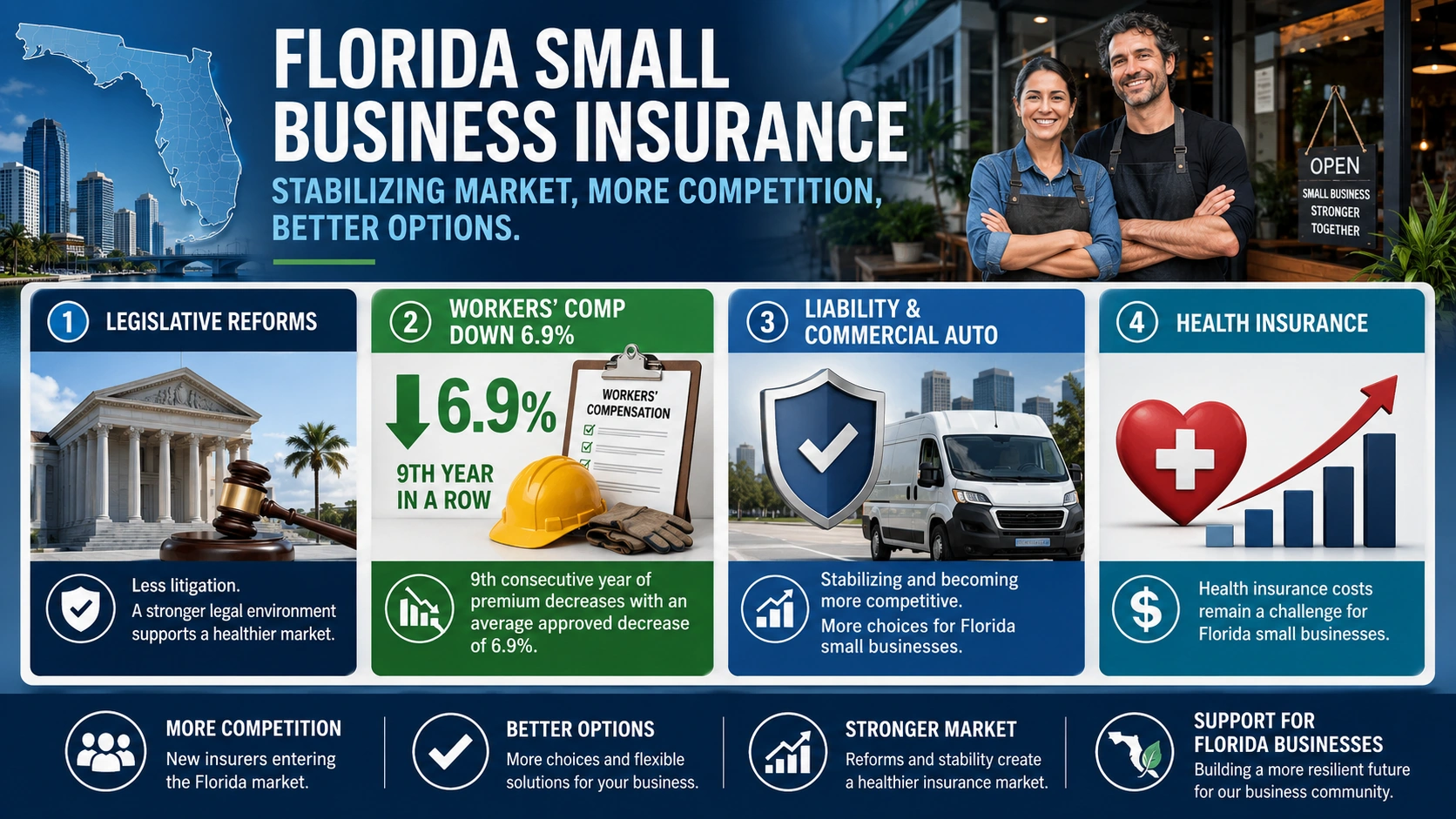
Three trends Florida business owners should know
- Workers’ compensation: the statewide overall rate level fell 6.9% for new and renewal policies effective January 1, 2026.
- Commercial property: surplus lines data shows growing policy activity and lower average cost in important commercial categories.
- Health benefits: small-group coverage remains available, but employers still face affordability and plan-design decisions.
The direction is encouraging, yet each line of insurance responds to different exposures. A lower workers’ compensation rate does not reduce commercial auto risk, and a business owner’s policy does not automatically insure professional advice, cyber incidents or every hurricane loss.
The coverage stack most small businesses should review
General liability and business property
General liability addresses allegations such as bodily injury or property damage caused by the business. Property coverage protects eligible buildings, equipment and inventory. A Business Owner’s Policy may package core protections for qualifying operations, but forms and exclusions vary.
Workers’ compensation
Requirements depend on industry, employee count and other factors. Even when rates fall, inaccurate payroll or class codes can create a costly audit adjustment. Read our detailed Florida workers’ compensation rate update.
Commercial auto
A personal auto policy may exclude or limit business use. Vehicles titled to the company, delivery activity, employees driving for work and hired or non-owned autos require specific attention.
Professional, cyber and employment-related risks
General liability usually does not replace professional liability, cyber insurance or employment practices liability. The right combination depends on what the company does, what information it stores and how it employs people.
The pain point: too many policies, too little certainty
“I pay for several policies and still do not know whether everything is covered.”
This is common when policies were purchased at different times from different sources. Build one exposure list first: property, people, vehicles, contracts, revenue dependencies and data. Then map each exposure to a policy and identify overlaps or gaps.
Belkys gives Florida owners one local point of contact for a coordinated review and compares available carrier options instead of starting with a predetermined product. Guidance is available in English or Spanish, helping owners and managers understand certificates, deductibles and exclusions without insurance jargon.
Renewal checklist for a Florida small business
- Update revenue, payroll, employee count, vehicle list and locations.
- Review customer and landlord contracts for insurance requirements.
- Confirm replacement values for buildings, equipment and inventory.
- Ask how hurricane, wind, flood and business interruption are treated.
- Remove former employees and vehicles; add new operations or services.
- Compare equivalent limits and endorsements before focusing on premium.
Owners with difficult property risks can also review our guide to Florida commercial surplus lines insurance.
Common owner objections
“My LLC protects me, so business insurance is optional.”
An entity structure and an insurance policy solve different problems. An LLC does not pay to repair damaged equipment, defend a covered liability claim or replace lost business income.
“A BOP covers everything.”
No policy covers everything. A BOP can be efficient, but the operation may still need commercial auto, workers’ compensation, professional liability, cyber, flood or umbrella coverage.
Sources
- Florida Office of Insurance Regulation: workers’ compensation rate decrease
- Florida Surplus Lines Service Office: June 2026 market report
- Florida Department of Financial Services: 2026 small-group health carrier list
Coverage requirements and eligibility depend on the business, industry, payroll, contracts and carrier rules. This article is general information.