What the latest Florida data shows
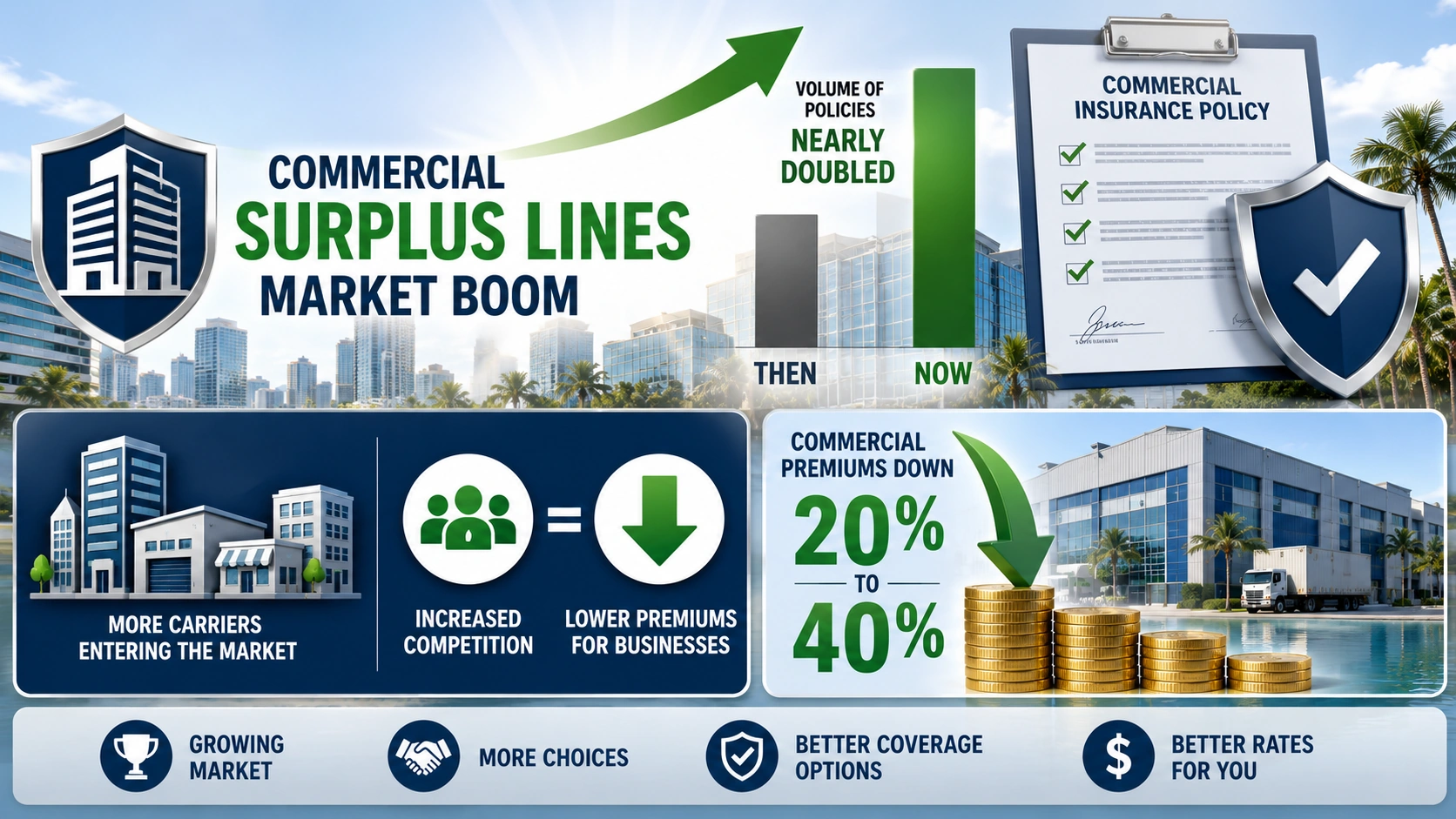
Through June 30, 2026, Florida surplus lines carriers wrote 982,627 policies, 15% more than a year earlier. Total premium fell almost 6% and average cost per policy declined nearly 18%, based on Florida Surplus Lines Service Office data reported by Insurance Business.
Commercial property was the largest segment, producing more than $3.3 billion in premium across roughly 193,000 policies. Its policy count grew sharply as average cost fell. That combination suggests improving capacity and competition for some risks that the admitted market may not accept.
What is surplus lines insurance in Florida?
Surplus lines insurance is coverage placed with an eligible non-admitted insurer when a risk cannot be appropriately placed in the standard admitted market. It is often used for coastal commercial property, unusual operations, high-value buildings, vacant property, special events, difficult loss histories, wind exposure or new businesses without a long track record.
“Non-admitted” does not mean unregulated or automatically unsafe. It does mean the policy operates under a different framework and generally does not carry the same Florida Insurance Guaranty Association protection as an admitted policy. That makes insurer quality and contract review especially important.
The business owner’s real problem is often availability, not price
“My current carrier will not renew the building. Do I have to accept the first alternative?”
No. A nonrenewal creates urgency, but urgency should not eliminate comparison. Begin early, assemble accurate property and loss information, and evaluate the deductible, valuation method, coinsurance, wind coverage, exclusions and carrier financial strength.
Another common frustration is receiving a lower premium with a much higher named-storm deductible or a roof limitation hidden deeper in the form. The policy that wins on price can lose when the business needs it most.
Questions to ask before accepting a commercial surplus lines policy
- Is the building insured at replacement cost or actual cash value?
- Are windstorm, hail, flood and business interruption included, limited or excluded?
- How is the hurricane or named-storm deductible calculated?
- Does coinsurance apply, and is the reported building value current?
- Are ordinance and law, equipment breakdown, water backup and cyber risks addressed?
- What inspections, warranties or protective safeguards must the business maintain?
Belkys helps small-business owners organize these exposures into one practical review and compare available market options. The agency adds two forms of value that automated quoting often misses: local Florida guidance for complex property risk and clear service in English or Spanish for owners who want to understand exactly what they are buying.
Explore our Florida business insurance options or read the 2026 small-business insurance outlook.
Common objections
“Surplus lines is always more expensive.”
Not always. It can price specialized risk more effectively, and current market data shows lower average costs in several commercial lines. The policy may also carry different fees, taxes, deductibles and exclusions, so total value must be compared.
“If a standard carrier declined me, nobody will insure the risk.”
A decline can mean the risk falls outside that carrier’s appetite, not that it is uninsurable. Complete underwriting information and the right market access can reveal alternatives.
Sources
- Florida Surplus Lines Service Office: June 2026 Monthly Premium Report
- Insurance Business: Florida surplus lines market analysis
Surplus lines availability, taxes, fees, forms and eligibility vary. This article is general information and not a coverage recommendation.